Day Four - Sunday, August 16, 2015
Updated: Apr 28, 2021

The last day in London.
It was a bittersweet morning, packing my backpack before leaving for more exploring of mystery locations. We didn’t dally over breakfast, there was too much to see before my early afternoon flight. Soon we were on a bus heading for Vauxhall. Or more specifically MI6 headquarters.
As we walked from the bus stop to the imposing Secret Intelligence Service building, we passed by businesses of all types, including Chariots Roman Spa, a gay bathhouse with a very imposing figure sitting by the entrance. (I did not take his picture, though I wish I had because it was announced recently that Chariots, and all of its locations in London, fell victim to the pandemic and will be liquidated.)
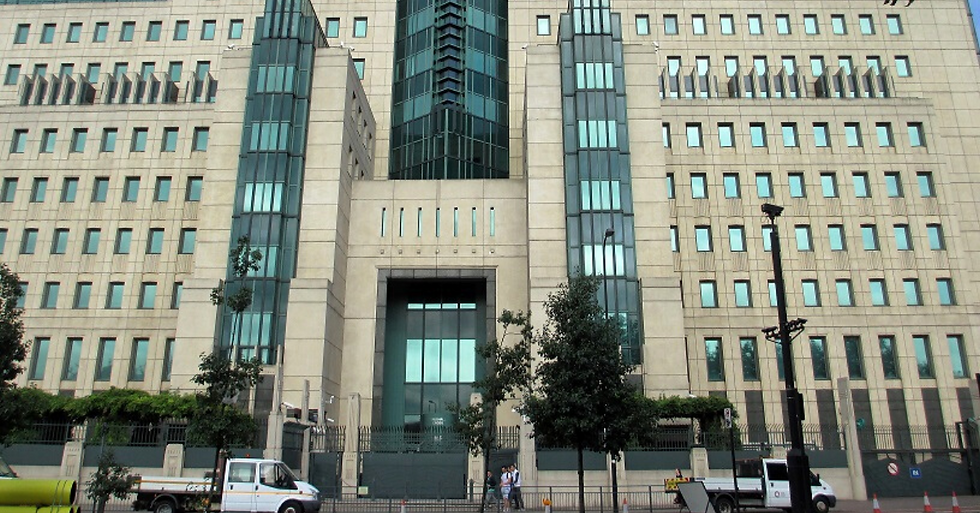
Ahead was a motorcycle shop and out front amongst the bikes parked on the street was a group of young men, maybe late teens and early twenties. As soon as they spotted us, they began moving to intercept and Ann calmly told me to ignore them and keep going, so I did. I was a few yards away when she caught up to me again. “They wanted to know if we wanted to buy some marijuana,” she said with a grin.
I looked up at the MI6 building (above) and then back at her. “They’re selling dope across from MI6?”
She shrugged. “It’s Sunday.”

We walked to the center of Vauxhall Bridge so I could get a picture of the MI6 building from roughly the same spot as when M watched her office explode in Skyfall (above, lower picture). It was a bit thrilling to be looking at the building where not only did Ian Fleming’s MI6 call HQ, but is also the real life MI6. A part of me was wondering if I would get in trouble for taking pictures, but we weren’t bothered at all.

The present MI6 building (there have been a few) in Vauxhall was completed in 1995, though MI6 moved in 1994. It has made more than one appearance in the James Bond movies, the first time in The World Is Not Enough. According to the SIS website, the architect, Terry Farrell, took inspiration from the local power station structures as well as Mayan and Aztec Temples.
The building is massive, standing just over 190 feet. It has 60 “roofs" with 10 floors above and five below ground, and uses 25 different kinds of special glass for the windows. Unfortunately, in Skyfall, the building’s reinforcements did not save it from Raoul Silva’s (Javier Bardem) wrath (or Tiago Rodriguez if you prefer). In Spectre the building is set for demolition, which Blofeld (Christopher Waltz) uses to trap and try to kill Bond and Madeleine Swan (Léa Seydoux).

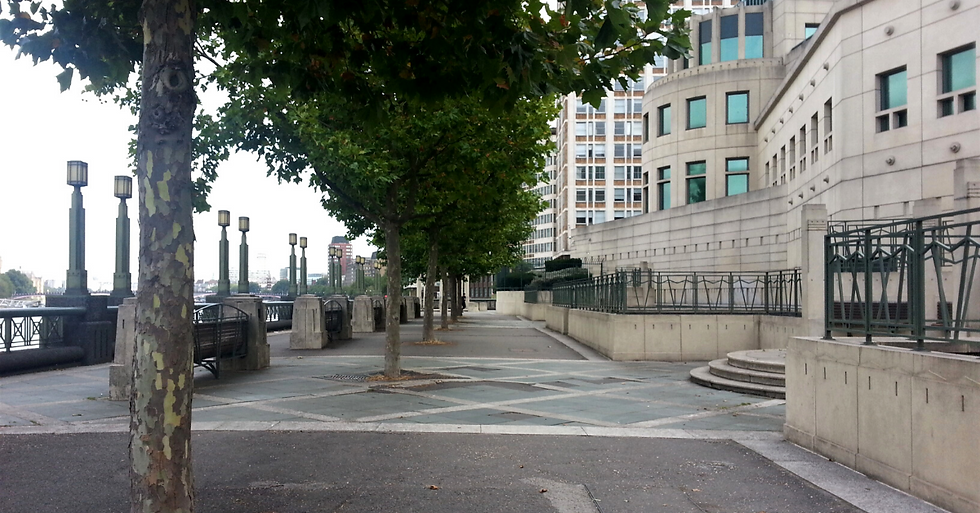
After taking more pictures of the building than necessary, we went back and walked along the Thames in front of the building, where I snapped more pictures. (I was pretty sure whoever manned the cameras around the building that day was urging me to move along - quiet Sunday morning or not!) The tide was out, and people were in the mud all along the river looking for treasures. Ann said they are known as mudlarks, and they are required to buy a license to legally operate on the Thames foreshore. Some of their finds can actually be seen in the Museum of London! I took a picture of two men on the foreshore in front of MI6 simply for a size comparison.

Moving along Albert Embankment, we passed by the London Fire Brigade headquarters, a massive building with a couple of the bay doors open so we could catch a glimpse of their vehicles; the International Maritime Organization with the bow of a ship coming out of its front doors (below); and saw a Thames Marine Policing boat pass by.


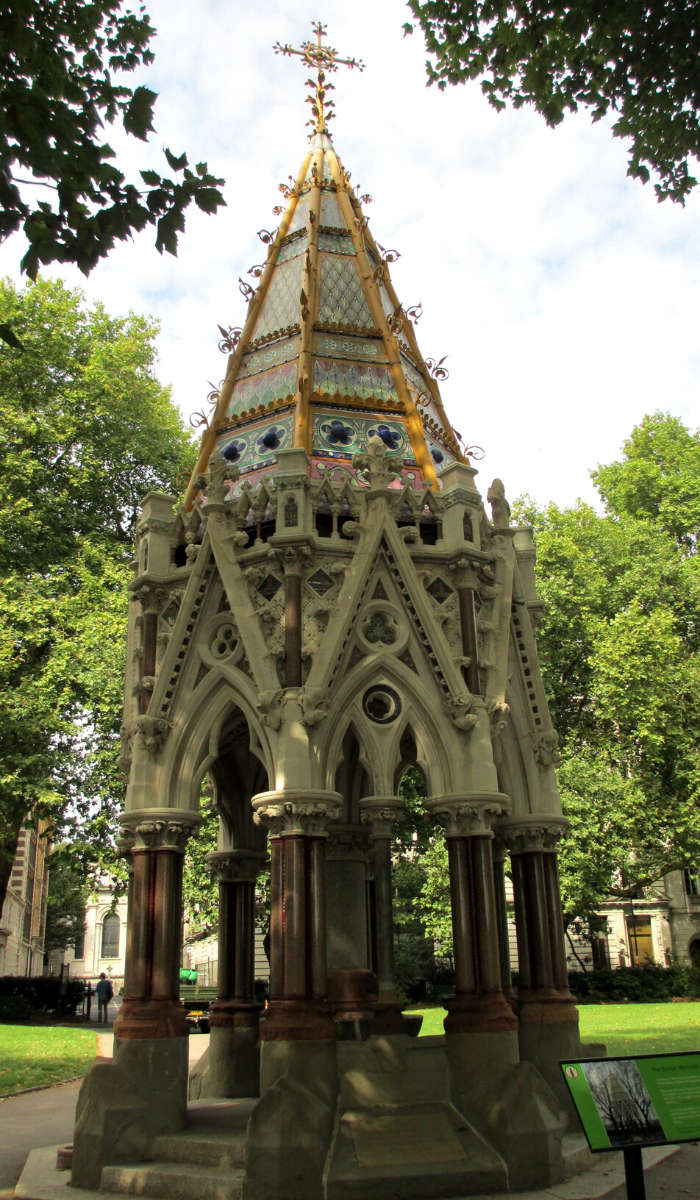
We crossed over the Lambeth Bridge to Victoria Embankment for a nice stroll along the river and through Victoria Tower Gardens, which is part of the Royal Parks System. Away from the hustle and bustle of the road leading to the Parliament building, the park has some fascinating artwork to admire. The Horseferry Playground keeps on a theme with half submerged wooden horse sculptures. The Buxton Memorial (below) was designed by S.S. Teulon and, according to the plaque, “erected to commemorate the emancipation of slaves following the 1833 Slavery Abolition Act.” It’s beautiful and so detailed one could spend an hour studying it.

Further along was the August Rodin sculpture “Burghers of Calais”, depicting the townsmen who offered themselves as hostages to stop the siege of Richard III. The expressions on their faces were heartbreaking.
The Emmeline Pankhurst memorial (below) is a tribute to the courageous woman who led the suffragettes in the fight to vote. It was created by AG Walker and unveiled in 1930, two years after she died. Sadly, she passed only one month before The Representation of the People Act was passed making it legal for adult women to vote in England, Wales and Scotland.

In the movie Suffragette (2015), Meryl Streep portrays Emmeline Pankhurst. Also in the film is Ben Whishaw, playing the fictitious character Sonny Watts.
Next up! Parliament! Big Ben! (Does anyone else hear that in Clark Griswold’s voice? Just me?)
Is a trip to London complete without a stop by Parliament and the Elizabeth Tower (renamed in 2012) where Big Ben hides and gongs on the hour? According to my camera - no.
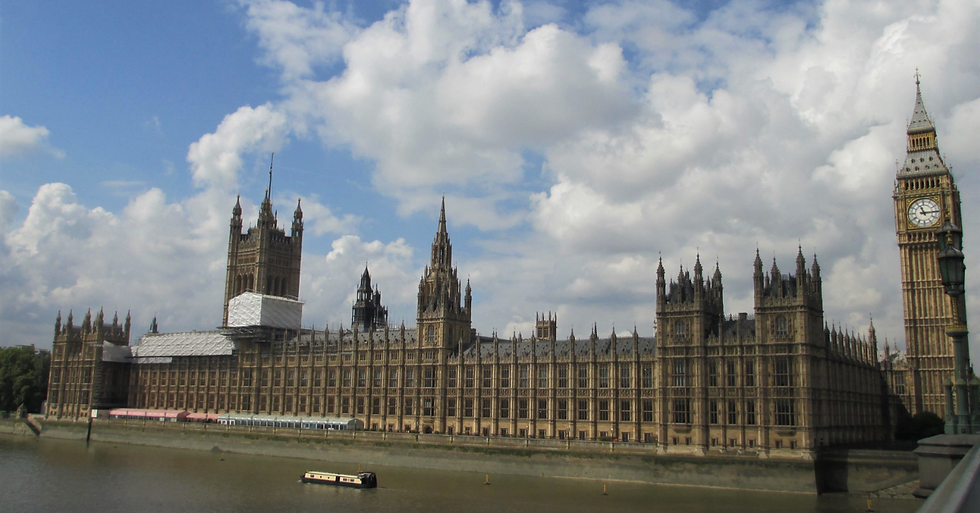
Narrowing down the number of times these buildings have appeared in the movies and television shows that I love was hard, but I got it down to four favorites: Doctor Who episode “The Empty Child” when Rose (Billie Piper) and Captain Jack Harkness (John Barrowman) dance in front of the clock face, Spectre as the background to the last confrontation between Bond and Blofeld on Westminster Bridge, the Sherlock episode “The Empty Hearse” when it is (almost) blown to bits, and Paddington’s aerial shot when the Brown’s are taking Paddington home.
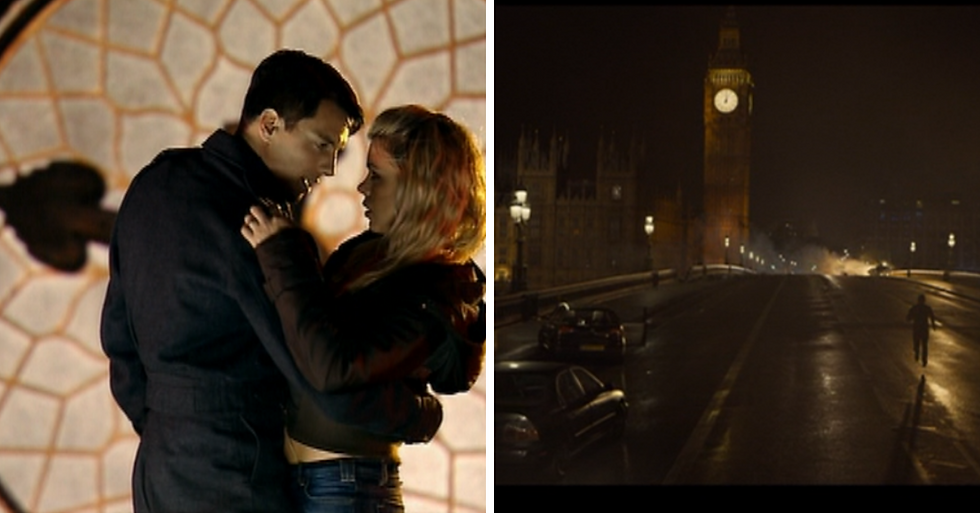
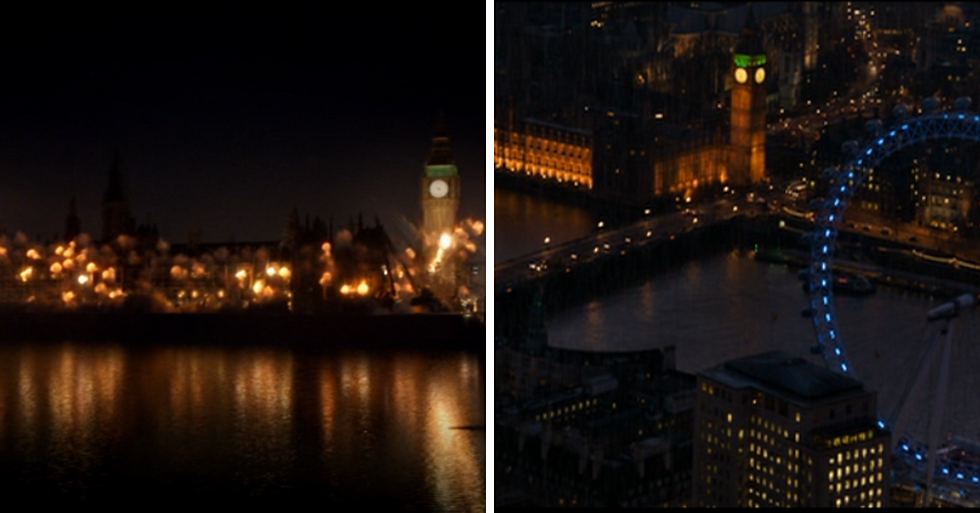
I almost added in the Doctor Who scene from “Aliens of London” when the Slitheen ship not-so gently grazes the clock tower, but I’d already used a screenshot of the ship flying past Tower Bridge.
What we see as the Palace of Westminster, or the Houses of Parliament, is relatively new in the scheme of things. It is a rebuild from 1840 due to the Great Fire of 1834 destroying the main buildings. In the 8th century a Saxon church was built on the site, later named West Minster. Houses of worship were primarily on the site until the 11th century when a palace was established by the Danish King Cnut.
The very cool fact I discovered while researching the history of this area is that it used to be an island! I’ve heard of London’s underground rivers, but never delved into it much. Now I know that the area was called Thorney Island, created by the Tyburn river meeting the Thames. The Tyburn is now part of the London sewer system.
Essentially, many of the London waterways were open sewers in Victorian times. Some of these were covered and buried in an effort to control the filth. And then came the Great Stink of 1858 when a hot summer day made the Thames, the end point for all of the new and much used flushing toilets, smell bad enough that something had to be done. Engineer John Bazalgette designed the sewer system that is still used today.

Back to the 11th century, when the Thames was actually thinner than it is today, Thorney Island was mostly marshland, but that didn’t stop Edward the Confessor from beginning construction on Westminster Abbey, and he also built a palace nearby so he could keep an eye on his abbey (where he was buried in 1066).
When William the Conqueror defeated the Anglo-Saxons, he continued the tradition of the palace and abbey being an important part of the monarchy. By the end of Henry III’s reign (1216-1272), the seat of royal and government power had moved from Winchester to Westminster. The palace officially became the House of Parliament after Henry VIII moved his royal residence to the Palace of Whitehall in 1512.
Over the years, additions and improvements were made until 1834 when most of the building was destroyed by fire. The design by Charles Barry was an example of the Gothic style that was popular at the time. It also blended well with the surviving buildings. It took 30 years and over two million pounds to build. Barry’s design is the building we know today, with the exceptions, Ann said, of the parts rebuilt after the Blitz in WWII. She also told me that the chamber The House of Commons uses was designed by Sir Giles Gilbert Scott, who also designed the original red telephone box!
And then, there’s Big Ben.

While the clock tower is commonly known as Big Ben, that’s actually the name of the bell that hangs within Elizabeth Tower, formerly St Stephen’s Tower. A quintessential icon of London, it’s not the first clock, or bell, in that space. In 1367 the people of London heard the first clock chime across the city. A little over 300 years later the tower was taken down and the clock replaced with a sundial. When Charles Barry was designing the Parliament rebuild, he included a clock tower, but getting the clock constructed was held up over arguments on how to make sure the clock would be as accurate as possible.
After the clock mechanism, designed by Edmund Beckett Denison, was completed in 1854, work started on the bell - the first one was cast in 1856. Unfortunately, it developed a crack, and a second bell was cast in 1858. On May 31, 1859, the Great Clock began to tick. On July 11th the City heard Big Ben ring for the first time.
The Great Clock is accurate to one second on the hour, and this was at the insistence of Sir George Airy, Astronomer Royal. I was so excited to realize that we arrived close to the hour, and I turned on my camera's video to capture the sound of Big Ben ringing.

Westminster Bridge, The London Eye, and the Sea Life London Aquarium
As we walked across Westminster Bridge I’m fairly sure I took two pictures for every step taken, which is a feat considering how busy the car and pedestrian traffic is. I suspect when there is filming on the bridge, it is a huge headache for everyone involved, and timed down to the second to make sure the disruption doesn’t last too long. Then again, if people are like me, they’d gladly make the time to watch a scene being filmed, especially if it’s for something as recognizable as James Bond or, as it happened in 1964 (and the recreation in 2013 for the Doctor Who 50th special), the Daleks crossed the bridge on their way to EXTERMINATE.

For as well-used and well-known as it is now, Westminster Bridge had a hard time coming to be, and it was all down to money. For the longest time, the only way to cross the Thames was to use the London Bridge or by ferry - and the people who profited from these two crossings were definitely not interested in another bridge being built that would divert some of the traffic and affect their profits. The two who profited the most being the Mayor of London and the Archbishop of Canterbury in 1664 when the first proposal was made. In 1726, the wooden Fulham Bridge was built, but it wasn’t enough for the rapidly expanding city.
People were tired of the inconvenience of not having a nearby bridge to cross the Thames, and in 1735, nearly 100 years after the original proposal, Parliament finally gave in. The bridge was designed by Charles Labelye. Labelye was originally from Switzerland, and his involvement was not welcomed by many of the English architects. It was to be built using wood, but that idea was nixed in 1739, and stone was used. It officially opened in 1750.
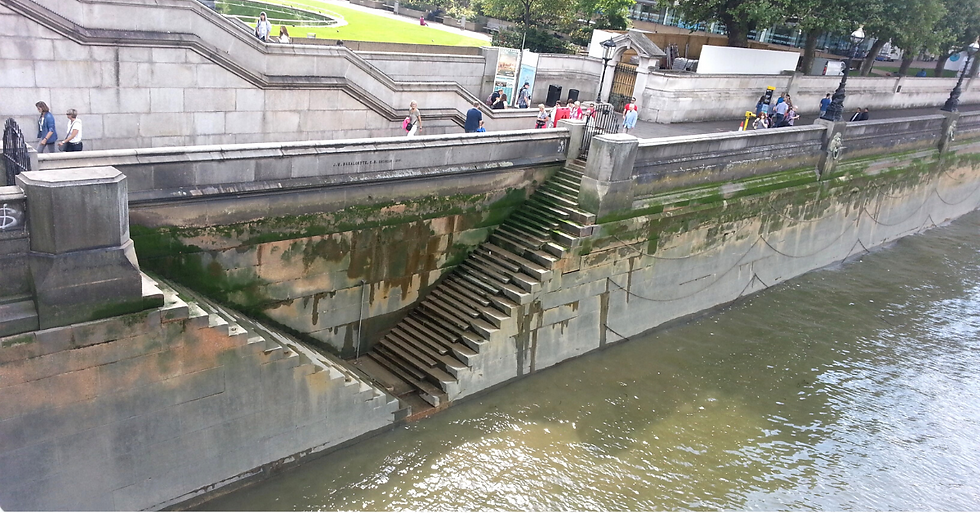
As we neared the Albert Embankment, I saw a filming location (above) that Ann hadn’t known about: the stairs Bond climbed from the boat he and Madeleine Swan had escaped in to confront Blofeld in the finale of Spectre.
Stairs like these, stone or wooden stairs leading down to the water, are all along the Thames if you know where to look. They are called watermen’s, or river stairs, and were used by the ferrymen who taxied people across the river as far back as the 10th century. They used to be found about every 100 yards along the riverside when they were in use, but due to lack of use and erosion, most are gone now.
We crossed over the bridge to walk along South Bank, and my neck hurt from trying to see everything at once. It was a beautiful day, the sky was blue and the thick, muggy air from the previous days was gone, encouraging locals, tourists, and performers to get out and enjoy it.

In front of the Sea Life London Aquarium (where Sherlock and Mary confront the villain in “The Six Thatchers”) is the London Eye. Another icon of London, the Eye played an important part of the Doctor Who episode “Rose” when it was identified as the antenna the Nestene Consciousness used to communicate with its Autons (above, right). I had the chance to take a ride on the Eye in 2009, and I was absolutely terrified until the views lured me off of the bench (where I’d had a death grip on the edge of the seat) and I started to, can you guess? Take pictures.
There wasn’t time to wait in line for a ride on The London Eye this time, the clock was ticking down to my flight taking off for a return to Northern Ireland, but that was okay because there was more to see in the meantime.

We passed by the National Theatre, BFI (British Film Institute), and iTV London buildings, which are all very interesting, but my attention was taken up by the people all around. Charlie Chaplin, for example, was on hand for pictures, and in return I gave him a pound coin. He kissed my hand and smiled in thanks.
There was, what looked like, a steampunk carnival getting ready to open, though only one performer could be seen, walking on a low to the ground tightrope. A group of people gathered around tables ahead ended up being an outdoor booksale which pulled us in and I very fittingly found an old copy of the Ian Fleming novel Diamonds Are Forever.
We grabbed a burger and fries (chips!) from one of the many outdoor vendors behind Royal Festival Hall (or maybe in front of depending on which direction you’re coming from) and then back up to the riverside to continue our walk - but not far because another filming location was right next door.

It was the graffitied skatepark used in “The Blind Banker”! It’s called the Undercroft skatepark (above), and is located beneath Southbank Centre. (It’s where Raz (Jack Bence) found more of the cypher symbols spray painted on the walls.) Opened in the early 1970’s, it became the center of British skateboarding, a celebrated space for the users, but the upstairs neighbors weren’t always so happy about it. Eventually they were able to get the skatepark closed to the public around 2005. Which means the actors using the area for the filmed scene were lucky skateboarders indeed.

SCREENSHOT of John, Raz, and Sherlock in the skatepark
Due to the fundraising efforts of Long Live South Bank, £1.37 million was raised to refurbish and extend the area for skateboard enthusiasts, rather than the originally proposed shops and cafes in that space. It opened in 2019. Invitations to add graffiti to the walls are always open.
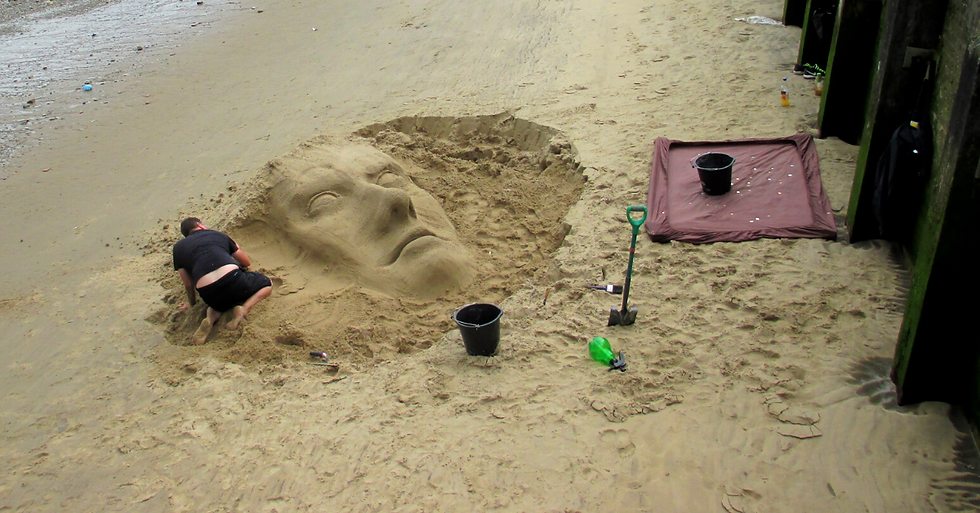
It was getting warm and the sun was very bright, and thankfully the trees along the way offered enough shade to keep us cool. There were so many street performers to admire, drawing crowds of all ages. As we neared the next filming location, there was a man creating a beautiful sand sculpture on the foreshore, and if you tossed a coin just right into the nearby bucket, it would ring a bell and the crowd would cheer. (I tried, the bell didn’t ring…)

My picture (2015) vs screenshot from episode (2010): notice that by the Cheesegrater building now blocks the view of The Gherkin.
In the shadow of the OXO Tower is the foreshore where Lestrade, Sherlock, and Watson investigate the body of an unlucky security guard turned amateur astronomer in “The Great Game.” Luckily, the tide was out (I’m sure Ann timed our visit to make sure) and I could get some pictures. We didn’t go down to the sand; maybe next visit when I’ll bring different shoes.


Next up was the Tate Modern (above) where Yoda was chilin' a foot or so above the ground, and we stopped for a few minutes to listen to a musician with a lovely voice. (A bit of fandom connection, a scene from the movie Enduring Love was filmed at the Tate. The artwork in that scene is part of the Turner Collection (same artist who painted The Fighting Temeraire that Bond (Daniel Craig) and Q (Ben Whishaw) sit in front of for their first meeting). The bit that ties it all together is that Daniel Craig is the main lead in Enduring Love and Ben Whishaw plays a small supporting role.)
Side note: While researching these locations beyond my own knowledge, I felt a little like Sherlock fitting the (clues) pieces of the fandom filming location histories puzzle together to create the full picture of how London is important to the film, fan, and travel industries.

The real Globe and a screenshot of the Doctor and Martha looking at a CGI version
Beside the looming presence of the Tate is Shakespeare’s Globe, the (re)creation of American actor Sam Wanamaker. The theatre opened in 1997 with two performance spaces: the Sam Wanamaker Playhouse, and the more famous Globe Theatre, based on Shakespeare’s own theatre which was a big circle. It is an open air venue and plays go on despite the weather, so if you have tickets you’d best be sure to check the weather forecast and dress accordingly!
The present Globe is actually the third, the first opening in 1599. It lasted until 1613 when a fire in the thatched roof burned the theatre to the ground. It was rebuilt and opened in 1614, but then closed down by Parliament in 1642. Thanks Puritans.

SCREENSHOT of The Doctor (David Tennant), Martha (Freema Agyman), and Shakespeare (Dean Lennox Kelly) inside the Globe Theatre
The Doctor Who episode “The Shakespeare Code” was partially filmed in the Globe Theatre, a location that David Tennant says in the Doctor Who Confidential “couldn’t be more perfect.” The cast and crew worked around the venue’s performance schedule, which meant limited time to redress the theatre to make it look like it might have in the 1500’s.
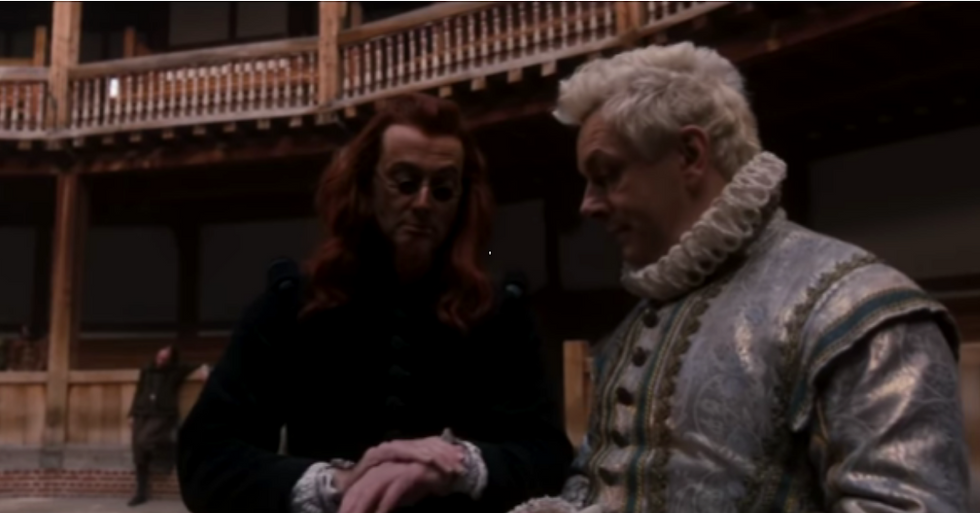
Interestingly, Tennant starred in another show where his character goes to the Globe Theatre. In Good Omens (2019) the demon Crowley (Tennant) meets up with the angel Aziraphale (Michael Sheen), who is happily watching rehearsals for the play Hamlet.

The rest of our walk was through the familiar area of Clink Street, past the Clink Prison (the inspiration for the saying "in the clink") which is now a museum, and the Golden Hinde replica of Francis Drake’s galleon used to sail around the globe. There is a Doctor Who connection here: the episode “The Talons of Weng-Chiang” filmed a scene in Clink Street in 1977. Tom Baker was the Doctor at the time. He was the first Doctor I ever knew when watching episodes on PBS in the States as a kid.


The last stop we made was at The George Inn (above) , which has been around since medieval times. Shakespeare and Charles Dickens were both patrons, but it wasn't used as a filming location, as far as I knew. It was just a piece of history that Ann knew I would enjoy seeing.
And then it was time to catch the train back to London City Airport. Did I cry a little walking down the steps to my train? Of course, but I also began to plan my next trip in another five years (takes a while to save up).
As we all know, 2020 did not turn out quite like we’d expected. The original research trip that would have taken me from England and Wales and across to France - I was even studying Welsh and French (but mainly Welsh) just in case - did not happen. The plane tickets were booked and I took a 24 month extension with the hope that I would try again in 2022.
The question is...
What fandom locations will we visit then?
Comments