Day One - Thursday, August 13, 2015
Updated: Apr 24, 2021

The day finally arrived when I would make my triumphant return to London (my previous visit was in 2009) for a four day, three night stay with my friend Ann.
My home base for my 2015 trip to the UK was in Castlewellan, Northern Ireland where one of my best friends lives. She and her family opened up their home and hearts to me for a week’s worth of sightseeing and catching-up, before seeing me off at George Best Airport in Belfast for a trip across the Irish Sea to London. (And then I would return to NI for another three days before heading back to the States.)

I was in the second row aisle seat with a good view of the cockpit, which meant I had the pleasant surprise of knowing that the co-pilot was a woman. I tried to get a picture but it didn’t come out. How awesome, I thought. I had honestly never heard of a female commercial airline pilot before. (According to the International Society of Women Airline Pilots, just over 5% of pilots are women.) I wish I could say it made me feel better about the flight, but my nerves stayed at their usual setting of “pre-flight jittery.” On the plus side, the man sitting beside me was asked to switch seats so I found myself alone in the two seat row. I quickly moved to sit by the window and got out my camera.
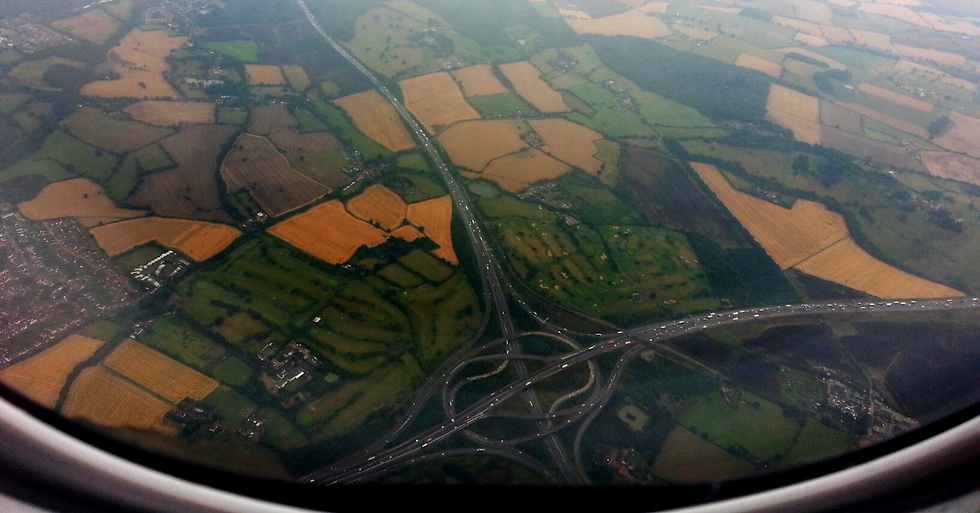
The next thing I knew, we were flying over the Irish Sea, a fairly smooth ride, and I had my camera to the window the whole way. There’s nothing quite like a bird’s eye view. The blue of the water, tiny ships that must be huge if they could be seen from so high, and then back to land with green and brown squares, highways bisecting the green, and then crowded cityscapes. Once I saw the Thames twisting through the land any anxiety I felt about flying was overtaken by the anticipation of being back in one of my favorite cities, exploring with one of my favorite people.

Flying over the Financial District (above) and seeing the familiar shape of the Gherkin (30 St Mary’s Axe) nearly brought me to tears with memories of my previous (first) visit. Meeting new friends and taking pictures of everything from historic landmarks to warbling pigeons had left a mark on me and I was eager to create more London memories.
We landed on time, at 3:10pm, and I hefted my tightly packed and zip-tied pack (I was not taking any chances of encountering a pickpocket or having one of the zippers forget to do its job), and disembarked the plane. I was able to bypass Customs because I was traveling from Northern Ireland and only stopped to use the bathroom and consult the last text from Ann:
Get yourself a one-way ticket to Waterloo from the airport. You'll need the Jubilee Line going west. Sit on the left side of the car and look for the O2!
I anticipated having trouble finding and getting the ticket for the DLR (Docklands Light Railway), but it was quite easy to get a ticket at the DLR terminal adjacent to the airport.

Out on the platform I shaded my eyes against the oddly bright but overcast day and stood with other travelers in front of the transportation Information display. I was looking for a sign that would tell me if the next train was going west. I didn’t find it. I did ask a few people for help but each one was also a visitor to the city, if not the country, and I think we were all just hoping that the incoming train was the one we needed.
I got in a train car that was bright and clean with only a handful of other riders, so we were spaced out (social distancing even in 2015!) and if there was conversation between the other passengers it was covered by the sound of the train. I sat on the left side as instructed, and began my usual vacation job of taking pictures of everything.
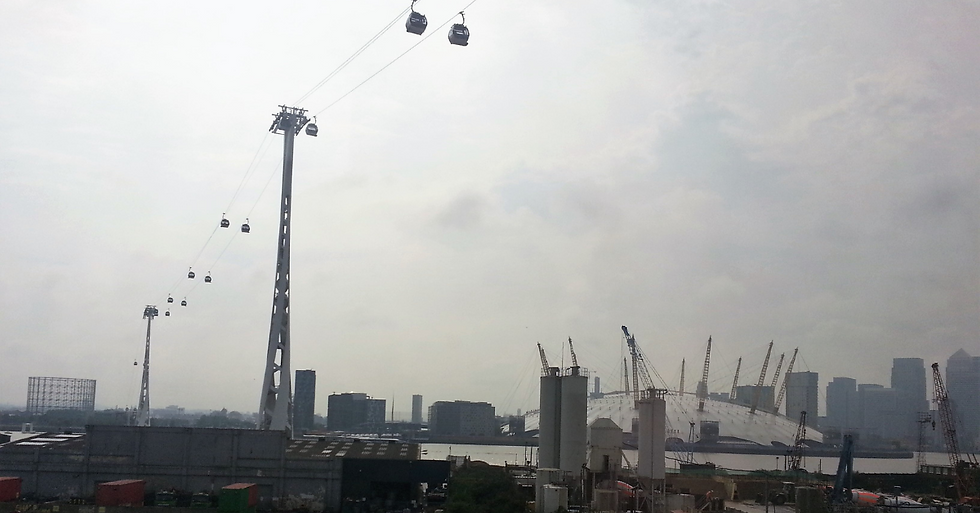
I was trying to figure out if there were people riding the gondola cars over the water, or if it was some kind of electricity wires I was looking at, when I saw the O2 aka the Millennium Dome (above). Why was that so important to me? Was it the famous concerts held there? No, it was because in the 1999 James Bond film The World is Not Enough, Pierce Brosnan’s James Bond fell from a hot air balloon to slide down the Dome to escape Giulietta da Vinci (Maria Grazia Cucinotta). Well, a stuntman did the dangerous bits. Of course, parts of the scene were filmed at Pinewood Studios, Buckinghamshire, but even recreating part of the Dome cannot replace actually filming on location. The Millennium Dome is also seen in the background during the ensuing speed boat chase on the Thames.

I turned around and smiled at the man sitting across from me. “The Millennium Dome!” I said, pointing. “How cool is that?” I was ready to tell him about the James Bond connection when I realized he was looking at me like I was using language best kept at home. I smiled in apology and turned back to the window.
Unfortunately, because I turned away to share my discovery, I missed seeing Canary Wharf, though some buildings from the area are visible behind The Dome in my picture. I didn’t realize I missed out until later when I was scrolling through Ann’s texts and she mentioned keeping an eye out for it.
The ride from City Airport to Canning Town station felt like just a few minutes passed before we were slowing down and I exited the car to find the train to Waterloo. There were two trains going in either direction and I needed to figure out which to take. I wasn’t even sure if I was on the right side of the tracks. So I asked a young woman, who shrugged and looked as confused as I was when she muttered in a language I was unfamiliar with. She did know “Waterloo” and my slight panic about finding my own way faded away in the face of helping her get to where she needed to be, which was conveniently where I needed to be. I gestured for her to follow me and went to the train car closest to us and stood in the doorway.
“Is this the train that goes to Waterloo?” I asked the fairly full car, and waited for someone to answer while I looked for two free seats. I nearly asked again because no one was speaking up, but then a young man came to the rescue. “Yes, it goes to Waterloo.” (According to Ann, Tube etiquette says that no local should make eye contact or attempt conversation - it’s not to be unfriendly or unhelpful, but most likely everyone was hoping for someone else to answer first!)
I thanked him and turned to my fellow lost traveler and nodded. “It goes to Waterloo,” I said. She smiled brightly - I think the both of us were feeling relieved that we’d taken the next step in the right direction. We got on the train, but sat separately, and my adventure continued. Loudly. I wanted to cover my ears, but no one else seemed bothered by the clangs and screeching of the train as it hurled us towards Waterloo Station, so I tried to appear the same. (I did end up covering my ears a few times.)

At Waterloo, I quickly lost sight of the other woman in the crowd, but hoped she found where she needed to be. I had my own path to take, and all I knew at that moment was it meant finding the stairs going up to the street.
Waterloo is the busiest train station in London, and also the largest - though that wasn’t always the case. It was opened in 1848 to replace another through station, and called the Waterloo Bridge Station. To look at it now, one would never think that it was originally not meant to be a terminus station, a final destination along a rail line. Over time, it was renamed simply Waterloo Station and, due to more passengers, expansion occurred bit by bit. It was not part of one big project because, like I said, it was never meant to be a terminus station. This piecemeal way of adding on to accommodate the station’s usage created many problems, mainly understanding how to get around the numerous sub-stations and platforms.
Knowing something had to be done, the London & Southwestern Railway decided to completely transform the station, which meant buying up entire streets, demolishing buildings, and even building others to rehouse those people who were displaced. The new station opened in 1922, presided over by Queen Mary (1867-1953).
The station was the site of several bombings during WWII. Platforms were closed for reconstruction, and the private Necropolis Station, used by funeral mourners, was destroyed in 1941, and was not rebuilt. In 1959, an unexploded 2,000 lb bomb was found during construction of a new building.
I knew none of this history of the station as I followed the crowd and eventually found myself exiting the station on busy York Road. I think if I had, I would have taken the time to explore, but luckily I didn’t because Ann was waiting for me.

I texted Ann to let her know that I had arrived and needed directions to the Starbucks, and then took a picture looking back towards Waterloo Station (above). The traffic, the people, the noise, the excitement of being back and seeing my friends again - of it all combined to muddle my brain a bit because even with Ann’s instructions, I ended up having a hard time finding my way around.
Station needs to be behind you, IMAX on your right. Go between two big buildings with matching windows and you should see Festival Hall. Go upstairs and you will see a bridge.
Except I didn’t see the IMAX theater because by the time I got her response I walked too far. Also, I had no idea what it looked like. (Spoiler: we later passed by it while on a bus and it was gorgeous and absolutely not what I was expecting.) I was looking for a stone building like the movie theater that plays IMAX movies near my house in Pennsylvania. I was not looking for a huge, round glass structure.
The excitement that had been fizzing in my blood all day turned to frustration at my apparent inability to follow directions. I found a spot along the fencing around a construction site and across from a restaurant with diners enjoying the nice weather. I needed to stop and get my bearings, and despite Ann’s directions I still had Starbucks on the brain so I opened the app on my phone.
As the app loaded, I leaned back a little against the high metal fence behind me to take some of the weight of my backpack off my shoulders, but straightened when I spotted a police officer walking towards me. Well, I would have straightened if the zip ties securing my pack zippers hadn’t tangled in the fencing. I moved and stumbled back, rattling the fence, catching the attention of the diners, and most definitely the attention of the officer. By the time the officer had reached me, a little wiggling had gotten myself free, and as he asked if I needed help I shoved my phone at him and said, “I’m looking for Starbucks!”
Because I am a rock under pressure.
He looked at the phone, looked at me, and then sighed and said, “Which Starbucks?” I looked at my phone and the search results listed several Starbucks in the area, and I needed...
“The one across the river?”
He just looked at me, and I began to babble about meeting a friend and seeing the Millennium Dome from the DLR and how I’d been in London before but not in this particular area… Ever have that inner dialogue that is telling you to please stop talking but you can’t? That was me in that moment. Finally he held up a hand and I gratefully to shut my mouth. He pointed and said, “Walk that way, go up the stairs and you’ll see the bridge.”
I thanked him, he attempted a smile and waved me off.

I went “that way” which was also following the railway like Ann suggested, and I stopped once for a pic of two London icons because how could I not? (And I got the chance to see them up close on my last day!)
Finally reaching Royal Festival Hall, I walked up the stairs and there was the bridge ahead. Obviously another photo opportunity that I couldn’t ignore.

Walking across one of the Golden Jubilee Bridges that flanks the Hungerford Bridge.
Ann was indeed waiting on the other side, and after hugs and a quick recap of my adventures so far, we set off. Since it took longer than expected for me to reach her, we skipped Starbucks because she planned a packed afternoon before we were to meet up with some friends.
London’s appeal for me is the contrasts. It’s a modern city with a rich, visible history. For example, our first stop wasn’t fandom related, but amazing all the same. An ancient sculpture beside the busy street on the Thames Embankment.
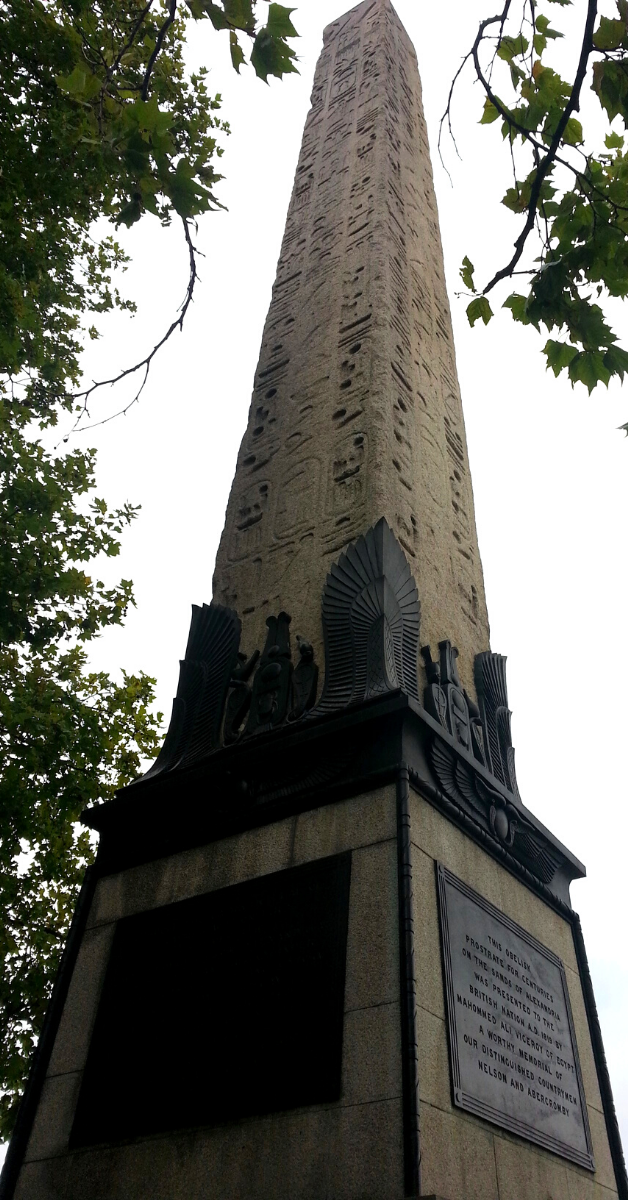
Cleopatra’s Needle (above) is an obelisk created in 1460 BC and gifted to London by the ruler of Egypt in 1819. It was “winched into position” in 1878 after a very long and expensive journey. There are still chips and chunks missing from the two bronze sphinxes set at the base of the obelisk from when the area was bombed in 1917 during WWI, which have never been repaired - left to commemorate the event.
We continued on and chatted about my time spent in Northern Ireland (Giant’s Causeway! Silent Valley! The Peace Maze!) and I steadily took pictures along the way. Eventually, we came upon this marker/statue announcing our arrival into the City of London. “I thought we were in London,” I said.

Ann explained that the City of London is the original London, and over time London expanded to the metropolis it is now. The City of London is the historical and financial district of Greater London.
It wasn’t long afterward that we turned to walk under an archway and seemingly through an enormous building with the most fascinating architecture. As we walked the cobblestone street, I thought it would make an excellent filming location for a historical series or film.
After a bit of research post-trip, I found that I was right, sort of. Both historical and modern films and television shows have filmed there.

Middle Temple Lane (above) is a narrow cobblestone road that looks like time stood still. Sherlock Holmes (2009), Pirates of the Caribbean (2003) and Mary Poppins Returns (2018) filmed along this road, or have filmed inside of the buildings. (Had I known what to look for, I’d have been more intentional when taking pictures, but alas, I just soaked up the feeling of being out of the modern world for a while.)
We emerged onto a busy street, like all streets seem to be in a big city, and turned right into Fleet Street. I kept falling behind because I was so busy trying to capture every bit of London life and architecture that I passed by. Even when when we stopped in front of Ye Olde Cheshire Cheese I still didn’t have a clue what was up, and figured we were going in because we were both thirsty. (The picture I took of the pub sign was too blurred to post, unfortunately.)

Ye Olde Cheshire Cheese is a dimly lit, small pub with wood floors and a homey feel. Rather than sitting at one of the tables or at the bar, Ann led the way down a hall and downstairs where the wood turned to stone and the air was a little chilly. She chose a table in what looked like a former cell block, and when I mentioned it she explained that I wasn’t too far off. It’s believed that in the 13th century a Carmelite Monastery stood on the site, and perhaps the little nooks were the monk’s cells (pictured below).
The latest incarnation of the pub began in 1926, but there has been a pub on the same site since the mid 16th century. That pub was a victim of the Great Fire of 1666, but soon it was rebuilt to enjoy a long, well-visited life. While I stared, wide-eyed and in awe of my surroundings, Ann left to get us drinks from the cellar bar.

I stumbled off the little ledge when I got up to take photos, but at least I was alone so no one actually got to witness the event firsthand. When Ann returned with a cider for me and a beer for herself, she told me that we were there because she had read that Sir Arthur Conan Doyle had spent time drinking there. A little research dug up the tidbit that a scene in “The Red Headed League” (a Sherlock Holmes adventure) was possibly modeled after the cellar in Ye Olde Cheshire Cheese. Despite being alone in the little nook, I noticed that we were speaking softly, though not reverently despite the room’s origins. Just before we left, a couple came in and sat at the back of the room, and they too kept their conversation barely above a whisper.
(Side note: To my amusement, while the whole establishment looks and feels as old as it is, the bathroom was clean and modern and brightly lit, nearly blinding me when I opened the door. And yes, I did take a picture but it’s not being added here.)
The alcohol and lack of sleep from excitement the night before were working together to sap my energy, so we quickly finished our drinks and continued on. The fresh air helped revive me as we walked to the next mystery destination. We stayed on Fleet Street for a bit, and I got a picture of the dome of St. Paul’s Cathedral before we turned into Old Bailey to see...the Old Bailey!

My picture of the Old Bailey door and a screenshot of John Watson.
The Old Bailey has made a few cameos in the BBC Sherlock series, but in “The Reichenbach Fall” there’s a good shot of John walking outside of the building, with the doorway in view. So I made sure to get a picture of that!

My picture of Lady Liberty and a screenshot of Moriarty and Sherlock.
I was able to get a good picture of Lady Justice, who also makes a cameo appearance in “The Reichenbach Fall." She sits atop the full dome, which can be seen (above) in the background between James Moriarty (Andrew Scott) and Sherlock. Fitting that a symbol of justice separates the two geniuses - one who solves crimes to bring criminals to justice, and the other who is the criminal.

My picture of St Bart's (day) and a screenshot from Sherlock (night).
It wasn’t long before we were at another familiar place: St Bartholomew's Hospital! Sherlock and John’s beloved St Barts. The show did not film inside scenes at the real St Bartholomew’s, but the infamous scene of Sherlock's fall from the rooftop was filmed on location.
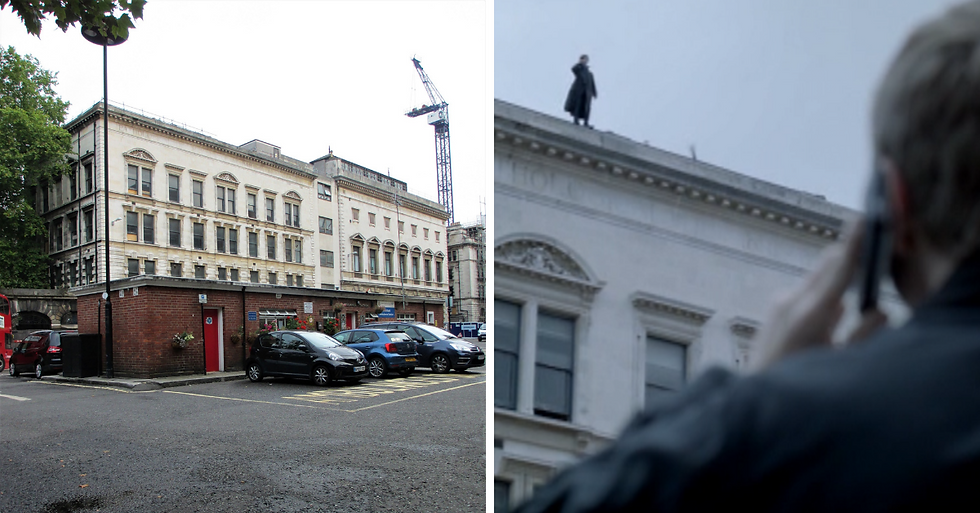
My view of the roof and a screenshot of John's view of Sherlock on the roof.
I tried to stand approximately where John Watson stood in the car park, speaking to Sherlock on his cellphone while staring up at him standing on the roof’s edge.
Just after I snapped my picture, two other Sherlock fans arrived. The only words we understood of each other’s language was ‘Sherlock’ and ‘St Bart’s’ but that didn’t seem to matter much in our excitement. We talked over each other and pointed and laughed, and I volunteered to play photographer for them.
I’ve been to other filming locations alone, or with friends (fellow fans or not), but there’s something special about meeting fellow fans who are complete strangers at these places. A first visit for all can be so emotional as you share, in whatever way that is communicated, your joy and excitement at being in that very spot you’ve seen on television or at the cinema. At least that’s how it was for me, and I think for those young women I met, as well. At one point, we were all quiet, just looking up at the rooftop, for myself, playing the scene of Sherlock’s fall in my mind. Perhaps they were, too.

The Henry VIII Gate and a peek inside the Church of St Bartholomew the Less.
Ann and I said goodbye so we could look around the area a little more. St Bartholomew’s is the oldest continuously running hospital in all of England, established in 1123 with the Priory of St Bartholomew. Most of the original buildings are gone now except for the tower of the Church of St Bartholomew the Less, and the history of the hospital is something you can almost feel as you walk around the campus. The Henry VIII Gatehouse boasts of the only statue of King Henry VIII for public viewing, and there’s a museum to visit (it was after hours when we were there so we were not able to go inside) where you can see a plaque commemorating the place where Sherlock Holmes first met Dr. John Watson in Sir Arthur Conan Doyle’s A Study in Scarlet. St Bart’s is also where Sherlock and John met in BBC’s Sherlock.


London is full of little oases and Postman’s Park is certainly one. Built on the former churchyard of St Botolph's, Aldersgate, the park opened in 1880 and is home to a memorial to “heroes” - men and women who sacrificed their lives to save others. The memorial was created in 1900 by the artist George Watts (1817-1904). (For a Sherlock Holmes connection, a scene from the movie Closer (2004), starring Jude Law, was filmed there.)

The next fandom destination was a surprising one: Tower 42, Old Broad Street (above), which stood in for Sebastian Wilkes’s Shad Sanderson Bank in the BBC Sherlock episode “The Blind Banker.”

The bright day seemed to make the tall building disappear into the sky, and later when I looked at the pictures I thought about how in the episode Sherlock determines how the graffiti vandal-slash-murderer committed the crime: “by running along the window ledge and onto the terrace.” And then I watched the episode again. When Sherlock looks down and the camera follows to give a view of the street below, my stomach swooped. Heights, not really my thing.
We did not go inside to get pictures of the lobby where Sherlock and John rode up the escalator, but you can see it through the glass (below). Steve Thompson, writer of “The Blind Banker,” said he wrote pages and pages to describe the Shad Sanderson Bank in the script, but hadn’t seen the location chosen until the morning the crew was shooting there and it came to life.

The QC code still works, by the way. If you’re able, just focus your camera phone on the code, or use a QC app reader to learn more about Tower 42. Or, just read on!
Tower 42, standing at 593 feet with 42 floors, was once the tallest building in London, but sadly is now only in the top ten. It used to be known as The NatWest Tower when NatWest Bank was in the building. Completed in the early 1980’s, the building took over 10 years to be completed, and then in 1993 was badly damaged in an IRA bombing. After reconstruction, the building was sold, and today is home to two restaurants and many businesses.
It was time to meet up with some friends at Balls Brothers Austin Friars, a very busy restaurant and bar, where we enjoyed a bit of drink and conversation while I changed out of my sneakers and into dress shoes. Why the change of footwear? Because we were having dinner at Searcys, at the very top of 30 Mary Axe, also known as “The Gherkin.”
It’s a short walk from the restaurant to The Gherkin, and the sun was going down which meant the lights of the city were turning on. My camera doesn’t take low light pictures very well, especially not while walking, so I just enjoyed looking around and talking to my friends along the way.
There were people all around the entrance to 30 St Mary Axe, taking pictures of the building, and I felt a little like a celebrity as we walked inside. The next part was a bit intimidating. We needed to show our identification, or in my case my passport, and be approved before we were taken to the lift (elevator) by a guard. The lift operator took us to the 34th floor, where we crossed the landing to take another lift to get to the restaurant on the 39th floor.

While The Gherkin (pictured above) is a familiar sight for anyone who has watched enough movies filmed in London that use aerial shots, I was excited to get to visit the building that featured in the “The Blind Banker.” When Sherlock is investigating the vandalism in Sir William Shad’s office, the audience, and then Sherlock, sees The Gherkin through the blinds (above). When Sherlock steps out onto the balcony, there is a direct shot, giving a hint of roughly how high up the office balcony is. (Hint: The Gherkin is 591 ft tall.)
Searcys is two levels of fine dining, and we were seated on the upper level with views of the city that made it hard to concentrate on the food at times. We enjoyed a wonderful dinner and finished off with celebratory drinks because it’s always a celebration when you’re together with friends. Especially when you haven’t seen them for a while.

The views of the city at night were incredible, and for once I didn’t mind being up so high. I even asked a couple if I could squeeze past their table to get a picture of Tower Bridge, which they graciously allowed (above). Unfortunately, after I took that picture, it was time to leave.
On our way to the bus stop, we walked with umbrellas holding off the rain to a very quiet Leadenhall Market (inspiration for Harry Potter’s Diagon Alley) and past Lloyd’s of London - which looks futuristic in the day or night. Sadly, all of my pics came out too blurred to post.

The Monument to the Great Fire of London (which ravaged the City of London over four days in 1666) absolutely needed to be photographed, even though it was raining and almost too dark for my old digital camera to handle. For a James Bond connection, Sir Roger Moore filmed a scene on the viewing platform for the film The Man Who Haunted Himself (1970).
We parted ways at the bus stop, Ann and I heading back to her flat, and our friends off for home. We were to meet up again on Saturday to see Benedict Cumberbatch in Hamlet at the Barbican so we said “see you soon” rather than “goodbye”.

I was exhausted after the long day, but still managed to take some pictures on the bus, to Ann’s amusement. An adorable Paddington Bear holding a box of my favorite tea from Tesco was waiting for me at Ann’s flat. It was nearing eleven by the time I crawled into bed, reminisced about the day in my journal, and fell asleep.
Comments