Natural History Museum - Paddington
Updated: Apr 28, 2021

SCREENSHOT of Paddington inside the MNH for the first time.
For the Paddington live-action movie, the villain (played by Nicole Kidman) is a taxidermist at the Natural History Museum. This means that the audience has the chance to see a bit of the museum - even if it’s pretty much all at night. In the screenshot above, Paddington is walking into Hintz Hall which is just beyond the main entrance. He walks past the skeleton of a Diplodocus, a skeleton that comes in handy when Paddington is later when he skips and bounces his way from head to tail of the skeleton to escape the clutches of Millicent Clyde.
When asked in an interview about which of the iconic sites the movie was filmed at was his favorite, Hugh Bonneville, who played Mr. Brown, chose the Natural History Museum. “And to wander around at night when there’s no one there I wouldn’t say is quite spooky, but it does have an atmosphere to it.” He added, “But it was fabulous to film there.”
While the inside scenes were mostly done on location inside the museum, the rooftop scenes were done on a built studio set with green screens. (I would say “obviously” but to be honest, the special effects are so good I would have believed they were up on the roof if not for the behind the scenes video I found on Youtube!)
And in case you’re wondering, the skeleton is a cast of a Diplodocus nicknamed Dippy.

PHOTO BY AUTHOR of Dippy the Diplodocus.
A quick history lesson
London’s National History Museum has an interesting history. The museum officially opened in 1881 as a collection housed in the Montagu House, and it was due to a high society physician named Sir Hans Sloane (1660-1753) that they got a start at all. Sir Sloane was a botanist and collector, in addition to serving his high class patients. During his travels, he collected interesting specimens for study, much of his early collection from his time in Jamaica when the transatlantic slave trade was operating. For years later, there was, according to the National History Museum’s website, a direct link between Sir Sloane’s burgeoning collection and the slave trade. And after his death in 1753, his Will allowed Parliament to buy his collection. The British Museum was built for the collection to be displayed to the public.
In 1856, Sir Richard Owen (1804-1892) became the first superintendent of the British Museum. Fun fact about Sir Owen is that he was the first person to use the word “dinosaur”. He also didn’t believe in Darwin’s theory of natural selection. He was an anatomist and paleontologist, top of his field at the time, and his own collection of research and letters is an important part of the Museum’s history and inventory. He is also the man who convinced the Board of Trustees that the collection had outgrown its original location (Great Russell Street) and needed a new, separate building.

PHOTOS BY AUTHOR of the Hintz Hall decorative motifs.
The new building, the same one people visit today, opened its doors in 1881. It was designed by Alfred Waterhouse and made entirely of terracotta which could outlast the London weather. The inside reflects the spirit of the museum, with animals and floral reliefs, and the colors chosen for the decorations are natural and calming. Waterhouse made sure of the accuracy of his decorations by consulting with experts in the field.
In 1963, a separate board of trustees was appointed for the collection, and the museum was renamed the Natural History Museum in 1992.

SCREENSHOT of the Natural History Museum and PIC BY AUTHOR
The Museum has physically grown over the years, with additions made to house new collections, but it’s the original structure that will always leave viewers in awe.

SCREENSHOT of Paddington running down the stairs to escape Millicent Clyde.
What it means to me
I did love Paddington Bear as a kid, but I have to be honest and admit that it was because Ben Whishaw voiced Paddington that I made sure to watch the movie. (And the second one!)
When I visited the Natural History Museum, it was very busy, which made picture taking a little hard, mainly because if I don’t want to randomly show up in someone’s pictures then I'm sure many other people feel that way about mine, so I try to be conscious of that. I had it in mind that the one picture I needed was of the dinosaur skeleton, but once I was inside the museum I found myself taking pictures for the joy of history. Thankfully, I did get some pictures that can relate to the movie, though of course I was taking daytime pictures which meant people everywhere.
Due to my interest in history where I was most definitely overshadowed why I was there. While my brain did drum up a movie scene or two as I explored the main floor, it was not the focus of my visit as it was with, for example, Speedy’s Cafe. I felt a little guilty about that, considering the reason for the visit was primarily for the Paddington connection, but that faded as I walked around and let the history of the collections sink in.
I think some filming locations, or places related to a favorite fandom in some way, will affect you differently, depending on your interests outside of the fandom. That doesn’t mean a visit to the location because it’s fandom-related is better or worse than another location, it’s just different. That’s something that I experienced over and over again during my weekend in London exploring different filming locations in 2015.

SCREENSHOT Google Earth view of The Natural History Museum.
Best way to virtually visit
The Natural History Museum is currently closed to in-person visitors due to the COVID-19 restrictions, but there are many ways to enjoy the museum virtually.
If you’d like to see more of the building itself, Google Earth can help with that.
Open the Google Earth app in Google Chrome or go to https://www.google.com/earth/ (Click "Launch Earth”)
Click the magnifying glass icon to search and enter “Natural History Museum London”
Use the + (plus) icon to zoom in (if using a PC) or enlarge the screen as you normally would on a phone or tablet - use the 3D feature for the best “view”
Click on the little figure icon to see the blue lines and dots show up indicating a closer view
Click on a blue line to enter Street View or one of the dots which is in the Photo Sphere (a user has uploaded their photos)
In Street View, the white arrows allow you to move along the street in different directions.

SCREENSHOT Google Earth view with Street View lines.
The majority of places where I clicked came up in the Photo Sphere in Street View and the pictures were all wonderful. The building is enormous, so it’s best to just “walk” along and see it bit by bit rather than try to see it in one shot - it’s almost impossible without being too far away to see the details. The aerial view gives a good idea of the overall size, and how long it might take to explore every room open to the public. And notice the Victoria & Albert Museum next door!
The Natural History Museum website is packed with information and virtual tour opportunities. I stayed on the Museum at South Kensington site because that is where I visited, but you can also go to the Museum at Tring site, which has even more to enjoy. That location is also closed to in-person visitors due to the COVID-19 restrictions.
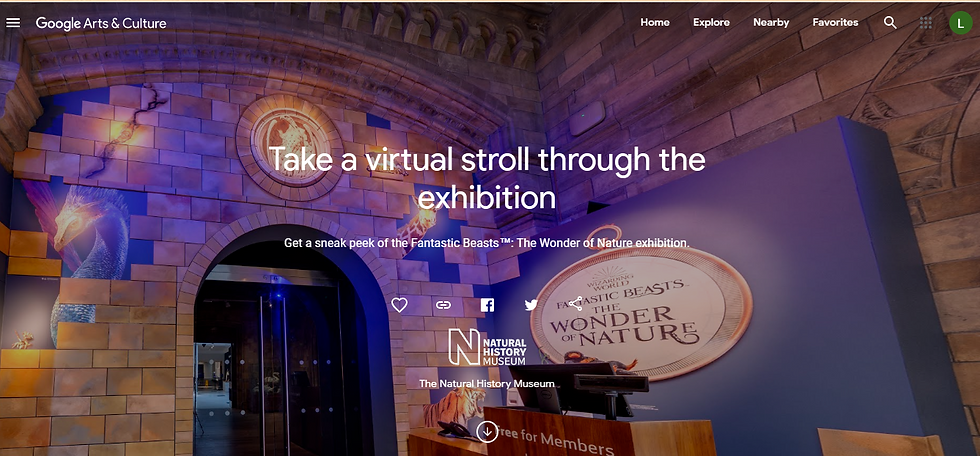
Scrolling down from the main announcement on the Visit page, there is a section that boasts of a Virtual Museum with 14 ways to explore from home! There is a 360 degree tour of the Fantastic Beasts exhibition, ways to go on a dig for dinosaurs, and my favorite: a virtual tour of the Museum itself!

Beginning in Hintz Hall, you can look around the main room, or choose a different room from the row of icons below. This is a collaboration with Google Arts & Culture that maps out the interior of the Museum.
There is so much to see, explore, and learn on the National History Museum’s website that, just like a real visit, it will take much longer than you anticipate, but you won’t mind at all.
Comments