Day Two - Friday, August 14, 2015
Updated: Apr 28, 2021

Day two started early, and after a breakfast of tea and brioche we were off. Like the day before, the sun was bright even with the clouds, but there were spots of blue sky peeking through. We knew it was going to rain later, so Ann had her umbrella and I carried my raincoat, but I really hoped we wouldn’t need them. It was already getting hot when we walked to the bus stop.


We caught a bus and Ann let me sit next to the window so I could take pictures. I was on the lookout for familiar and/or famous landmarks. I finally found the IMAX theatre Ann had told me to look for the previous day which made us both laugh. I got a quick snap of the National Theatre building (check out their NTLive website!), and I rarely let a red telephone box pass by without making it a mental and digital memory.
We got off near the London Euston stop for the Underground and I was immediately distracted by the number of non-English newspapers available. “For the ex-Pats living in London,” Ann said, leading me away before I could collect one paper from each stand to admire the languages (even if I couldn’t understand them).
We turned into a residential street and I was oblivious to the gem just yards away, too busy taking pictures of the street signs and neat rows of flats. “Do you know where we are?” Ann asked.
“Should I?” I wasn't really paying attention because I was wondering what the flats looked like inside.
“There.” She pointed ahead and I let out an honest to God gasp.
“Speedy’s! That means . . . Baker Street! 221B!

Actually, it’s not the real Baker Street, and the number on the door beside Speedy’s is not 221, but I took pictures anyways. It was more about how the actors and film crew had been right there for so many scenes over the four seasons - magic was made on that spot.
Speedy’s Sandwich Bar & Cafe located at 187 Gower Street was made famous by appearing several times in the BBC’s Sherlock as 221B’s next door neighbor. Mrs. Hudson (Una Stubbs) even had a bit of a fling with the owner, Mr. Chatterjee, as Sherlock deduced in “The Hounds of Baskerville.”

Speedy’s isn’t in the novels, but for fans of the BBC’s modern Sherlock it has become a part of the show like a secondary character. To have the chance to go inside the small shop and order tea and pastry made my day.
We were able to sit at one of the tables outside, across from a trio of women having a quiet but animated conversation. I tried not to eavesdrop but when I heard a distinctive American accent I couldn’t help but ask, “Are you visiting from the States?”
They were, well, two of them were. They were visiting Sherlock filming locations before the big event later that evening: they had tickets to see Benedict Cumberbatch in Hamlet. “We’re going tomorrow,” I told them, and we chatted until our second breakfast arrived.
I ordered Earl Grey tea with a chocolate croissant and neither disappointed. A German-speaking couple sat at the table beside us just as Ann and I were finishing up. For me, growing up in a small New England town, big cities were intimidating because of the noise, the crowds, and the tall buildings. As an adult, I still gaze in awe at the tall buildings and the noise can get overwhelming, but the people are less intimidating and more interesting.
What fascinates me the most is how many languages and accents you can hear in a big city. French was what I heard as a kid with Canada just a few hours’ drive away, later Spanish and Indonesian through work friends, but in a city like London there’s no limit to the number of languages and accents you can hear.

We said goodbye to my fellow Sherlock fans and moved along down the street. I turned to get a few more pictures, my own private goodbye to the fictional 221B and the very real Speedy’s. That evening, I went through the pictures from the day and found my favorite when I zoomed in: I was photobombed by a young girl and didn’t even known it at the time. Whoever you are, you made me laugh, and even now I can’t help but smile when I see it.
Our walk took us past many more residential buildings that caught my eye before we made it to our next destination: The Regent’s Park. Filled with curious squirrels and magpies, this beautifully landscaped and popular park is much larger than I realized on my visit. We only walked in one small (but important for this trip) section, but the park itself is known for the London Zoo, Primrose Hill with its history of duels and prize-fights, and the largest open air theatre in London. It is 197 hectares (if including Primrose Hill), which works out to over 480 acres of land.

We entered the park at Chester Gate and the English Gardens was a riot of colorful flowers, chittering squirrels, and squawking magpies. Ann told me that you should always say “good morning my lord” to a lone magpie. Seeing a lone magpie could mean bad luck was coming. Whether that was true or not, I took no chances.

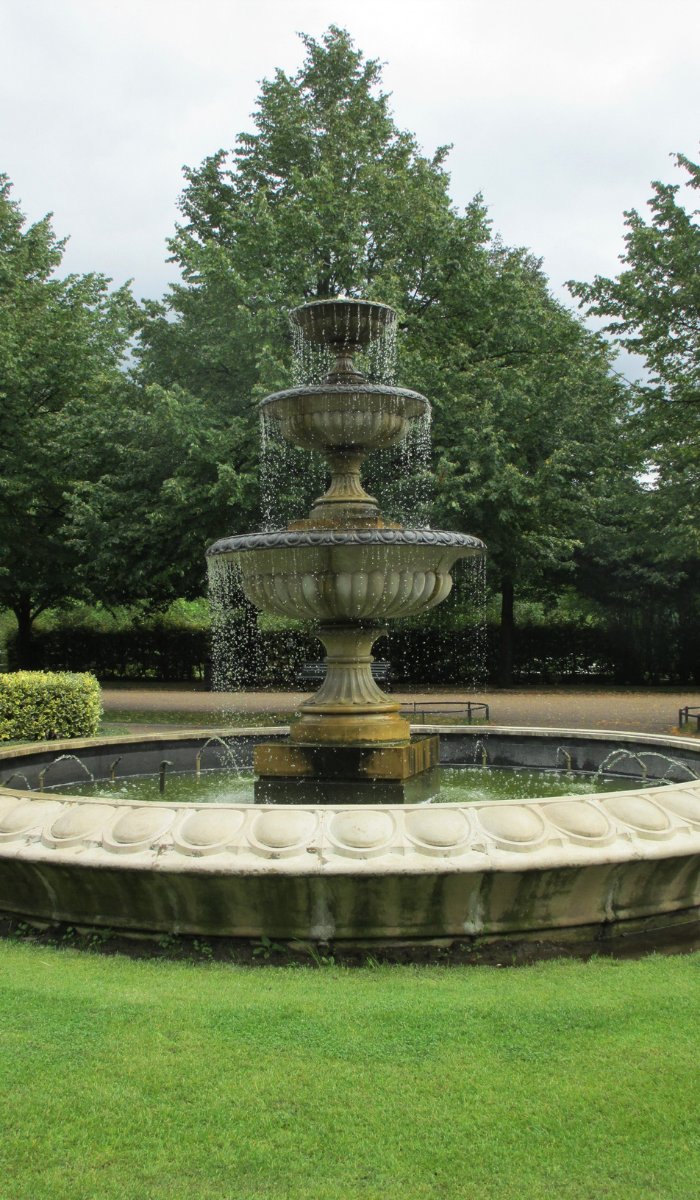
We passed by the Griffin Tazza (aka the Lion Vase) in Avenue Gardens, which was installed in 1863, and I took a few pictures of those talkative magpies. I was especially excited to get a picture of the water cascading down the sides of the Avenue Gardens fountain.
As we walked along a paved pathway, geese and ducks quacked and waddled around, cautious of the humans sitting on the benches or walking along the path like us, but not afraid. The waterway running through the park, Regent’s Canal, was graced with swans and nests with little fuzzy headed chicks.


While the park is no stranger to film crews, though it is the zoo that is most popular (Harry Potter had a conversation with a snake in the Reptile House of the Regent’s Park Zoo), we were there for the connection to spies. Not only did the Regency terraces of the buildings outside of the park serve as a backdrop for Washington DC in Spy Game (2001), but more importantly they were possibly the inspiration for Ian Fleming’s MI6 in his James Bond novels. A specific description is not given, so I will just pretend these could have housed the fictional MI6. Maybe Bond and “M” stood at one of the windows overlooking the park and discussed the next mission while watching the various types of birds that dotted the grass and the swans floating on the canal. Did you know that any unmarked swan is property of the crown? Neither did I, until Ann told me while I was trying to take pictures of one.


I think my favorite part of parks in a big city is the illusion that you’re not in fact in a big city, and that when you leave the park and encounter the cars, quick moving pedestrians, and buses, it all comes crashing back - and I might have considered turning right back round to sit on a bench and watch the birds but Ann revealed our next destination: Baker Street - the real street in London NW1.
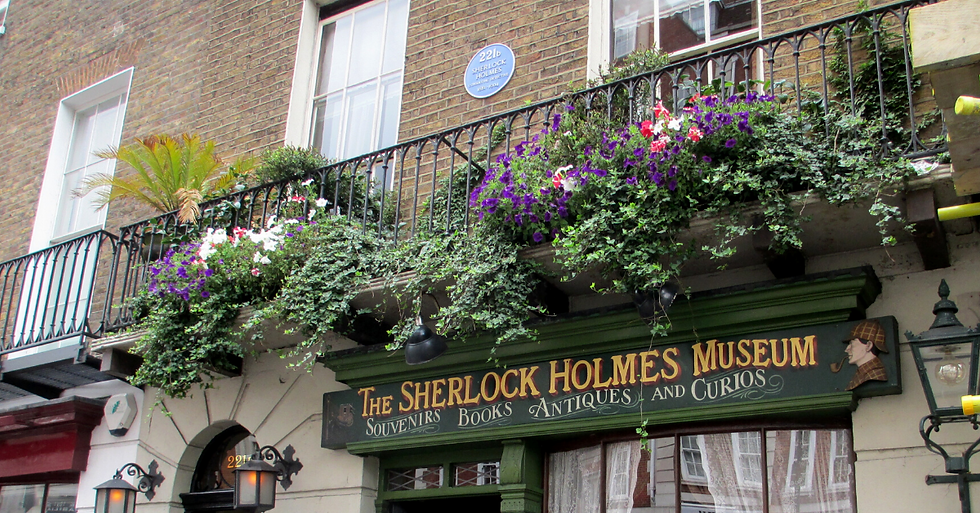
Ann’s plan included a visit to The Sherlock Holmes Museum, but the long line created a change of plans. While the Sherlock Holmes fandom is more than just the BBC modern day version, I had a feeling that many people were in London at this time to see Benedict Cumberbatch in Hamlet, and visiting the Sherlock Holmes related sites was part of the pilgrimage. Since I was still reeling from actually getting to sit and have a bite to eat at Speedy’s, I couldn’t find fault in their plans. I was doing a bit of the same, just not focusing solely on the Sherlock related sites.

The line is actually two lines, coming in from either direction. The museum has the window boxes overflowing with plants.
While the museum boasts of the address 221B, that address didn’t actually exist when the Conan Doyle stories were published, nor when the museum first opened at 239 Baker Street by the Sherlock Holmes International Society. Eventually, the museum was given special permission by the City of Westminster to readdress the residence as 221B. The site is treated as if it really was the residence of Sherlock Holmes, Dr. John Watson, and Mrs. Hudson - the first floor is set up according to the novels as Holmes’s study, and the overall décor brings the Victorian era to life.
There’s even a floor with wax figures acting out famous scenes from the novel, as well as live actors playing the parts of a maid, Mrs. Hudson, and a police officer who guards the entrance to the museum.
The building itself dates back to 1815, and is a listed residence that even has a plaque to commemorate its famous former resident.
We caught another bus and again I sat by the window to take pictures of the passing buildings and scenery. We were on Oxford Street, one of the famous shopping districts in London, and passed by Selfridges and Burberry, then over to Knightsbridge home of Harvey Nichols and Harrods.
Selfridges founder, Chicago-born Harry Gordon Selfridge, and his charismatic and innovative spirit were the basis of the Masterpiece Theatre series Mr. Selfridge, starring Jeremy Piven as Mr. Selfridge. The four season show covers the beginnings of London’s first department store, and was an adaptation of the book Shopping, Seduction and Mr. Selfridge by Lindy Woodhead.
Harvey Nichols featured often in the hilariously irreverent and scathing series Absolutely Fabulous, starring Jennifer Saunders and Joanna Lumley. The references to Harvey Nichols, or Harvey Nicks, began in the very first episode called “Fashion” and continued on throughout the show’s five seasons. The high-end superstore, which began as a small linen shop in 1831, even held a contest in 2019 to “Have your own ‘Ab Fab’ Experience at Harvey Nichols” with a £50 voucher as the prize.

While the ride through the shopping districts to see the gorgeous architecture was enjoyed, it was not our next destination. The Victoria and Albert Museum (the V&A), pictured above, was not used as a filming location for any of my fandoms for that trip, but it is a must-see stop for fans of creativity. I could have spent a month or more lost in the halls surrounded by some of the most glorious works of art through the ages ever seen. Despite being separated from many pieces by thick glass or plastic, just looking at an ancient scroll, piece of furniture, or bit of old fabric could make the shuffles and murmurs of the other visitors fade away as I imagined a world when the piece was new.
The V&A began as a Museum of Manufacturers in 1852 and over the years has evolved into a massive collection of creative design spanning over 5,000 years. As with any museum, there is so much to see it feels impossible to devote enough time to learn and absorb everything each piece wants to tell. We explored the rooms with artwork from Medieval Europe to Ancient China, before visiting the gift shop which serves as an interchange for another part of the museum.

A rare tomb model of a horse, AD 25-220 Eastern Han Dynasty.

Across a courtyard bustling with people is the wing that houses the ‘Cast Courts’ showcasing larger sculptures and pieces of ancient architecture. We stood in awe staring up at the huge plaster cast replicas of ancient columns, reliefs, and sculptures, such as Michelangelo’s David. I didn't understand until I was standing in front of it just how massive David is. It seems smaller in pictures and on the television, of course. Each replica looked aged, as if it was the real thing. The detail of each was mind-blowing. I only knew a few of the names of the artists, but for all of the artists I was overwhelmed with a wave of respect and wonder of their talents.

My view of the skeleton of a Diplodocus nicknamed Dippy, and a screenshot of Paddington seeing Dippy and the Museum for the first time.
The next destination was literally next door: The Natural History Museum. If you’ve seen the 2014 live-action Paddington movie, The Natural History Museum is where Paddington Bear and his family outwitted Millicent Clyde (Nicole Kidman), the evil taxidermist who wanted to add Paddington to the museum’s collection.

I enjoyed the Paddington Bear stories as a child, but what made me watch the live-action movie was the fact that Ben Whishaw voiced Paddington Bear! Whishaw is one of my favorite actors, and he played the new ‘Q’ in Skyfall and Spectre, (and will be in the upcoming No Time To Die) in the Daniel Craig James Bond movies. He also played Michael Banks in Mary Poppins Returns (2018), Sonny Watts in Suffragette (2015), Danny in the 2015 mini-series London Spy, and so many more. I was looking forward to seeing him in the play Bakkhai at the Almeida Theatre on Saturday (yes, only a couple of hours after we were to see Hamlet.)

While Paddington evades Millicent Clyde in the dark and deserted museum after hours, we were there with the crowds. That didn’t stop me from taking as many pictures as I could. Not only because of the movie, but because the museum itself is gorgeous and filled with beautiful decorative reliefs, in addition to the displays..

Once we moved out of the main display area and into the wings, Ann led me to a particular display (above) featuring one of the first officially recognized female paleontologists that she read about. (What we didn’t know at that time was that in 2020 Kate Winslet would play Mary Anning in the movie Ammonite. And more, when I originally was deciding on a Capstone idea, I wanted to create a paper magazine and used a copy of Britain Magazine as a formatting example - which had an article about Mary Anning and the movie inside.)

We skipped lunch and by the time we were to meet a friend at Bella Italia in South Kensington, we were famished. Due to the light rain falling, we were also in need of a place to dry off. My travel journal notes on this stop were: “Nice waiter, ate way too much, drank an enormous pear cider.” Vague descriptions because I was more interested in the conversation the three of us enjoyed during our meal. When you don’t get to see good friends in person for years at a time, you have a lot to say - even if you’ve already said it in a text, email, or card. After a nice cappuccino to end the meal, we parted ways with a promise to see each other again on Saturday for Hamlet.

Ann revealed the next destination without me asking because it was going to be a bit of a walk: Leinster Gardens! Sherlock fans might remember this location from the series three episode “His Last Vow.” I was doubly interested in the site because I had seen a documentary called Secrets of Underground London on PBS that quickly mentioned the façade “building” before my trip. (You can watch clips on the PBS site, and Part 4 is about the beginnings of the Underground.)
It was still lightly raining as we walked, Ann under an umbrella and me in my raincoat, and the air was thick with humidity. We first mistakenly went to Leinster Square, which wasn’t a bad thing really because Ann and I can talk about anything and even walking in the heat I didn’t mind taking the long way around. We resorted to using the GPS on my phone to find Leinster Gardens.

The both of us being fans of the Lord of the Rings movies, we had to stop and make note of this sign and spent some of our walk spouting off quotes made by Strider (Viggo Mortensen), “one of them Rangers from the North.”

When we found the correct buildings I was surprised. In the episode “His Last Vow,” there are no trees in front of the building, or else he couldn’t project images against the façade. Well, that’s because the shot wasn't taken directly between 23 & 24 because there are two trees planted there and allowed to grow and cover much of the front of the façade. Number 23 is the black door and number 24 is the white door. It was difficult to get a direct shot due to the cars parked right where I needed to stand.

You’ll notice that some of the windows appear frosted, rather than clear with curtains, also there are no knobs on the doors. This is because numbers 23 & 24 are not real houses but facades built to hide the gap for the old Metropolitan Line of the Underground. Open gaps were used for ventilation due to the amount of hazardous smoke the steam engines produced in the tunnels. The original 23 & 24 were demolished in the 1860’s to make way for the railway, but cleverly rebuilt to give the beautiful mid-Victorian terrace a seamless façade.
In the episode, when Sherlock is missing and everyone is looking for him, Anderson (Jonathan Aris) tells Mary (Amanda Abbington) that Leinster Gardens is Sherlock’s “number one bolt hole. Top, top secret.” When she goes to Leinster Gardens (below), Sherlock says to look for “The lie. The lie of Leinster Gardens hidden in plain sight.” He also claims to own the house by “winning it a card game” and leaves the door open a crack for Mary to come inside.

Since the façade is 5 foot thick concrete designed to look like a house with nothing behind, when Mary goes inside I believe she’s actually entering number 22 which is a real house, well, as of 2007 it was rebuilt and now houses 7 individual apartments. The scene that takes place inside is, I believe, like the inside of 221B Baker Street, a specially constructed set located at a studio in Cardiff.
Creators and writers Steven Moffat and Mark Gatiss (who also plays Mycroft Holmes, Sherlock’s brother) were very pleased to have the Leinster Gardens facades in an episode. They had been trying since episode one. “...I think it’s the most exciting thing in the world. I love it,” Gatiss said in a 2014 Empire interview. “It’s the coolest thing in the world,” Moffat agreed. “And I love the idea that people are now going to go there.”
Our next stop was a short walk from Leinster Gardens: Paddington Station. It’s an incredibly busy train station, least of all because of its connection to Michael Bond and Paddington Bear, but of course that’s why it had to be a stop on our adventure.

Paddington Station was originally meant to be of a grand design by Isambard Kingdom Brunel, but due to costs the plans were scrapped for a smaller, temporary station instead. Much like Waterloo, the temporary station saw much more traffic than anticipated and it had to be extended to accommodate the people.
Brunel, influenced by the Crystal Palace for the Great Exhibition of 1851, designed a glass and wrought iron three span-roof for the station. Fox Hendersen & Company were hired for the actual construction of the station. There has been much expansion over the years, and in the 1990’s the glass in the roof was replaced with polycarbonate glazing panels (which is 200 times more impact resistant than glass).
So where does Paddington Bear fit in with Paddington Station?
In 1956, Michael Bond, a cameraman for the BBC and a writer, saw a teddy bear sitting all alone on a shelf in Selfridges on Christmas Eve, and he felt so bad for it he purchased it as a gift for his wife. He named the bear Paddington because his home was near Paddington Station. The little bear inspired him, and he began writing stories with the bear as the main character.
Williams Collins & Sons, now Harper Collins, published the first book in 1958. A Bear Called Paddington was illustrated by Peggy Fortnum, and kicked off a whole series of books that allowed Bond to later become a full-time writer. For the live-action movie, the Brown family find the young bear inside of Paddington Station and name him accordingly (since they can’t pronounce his name in bear language).


There were two Paddington Bear sculptures to admire when I visited. One is the original, and created by Marcus Cornish. It made its appearance at the station in 2000 and the pedestal is a popular place for people to have a seat with the resident orphan bear.
The second Paddington Bear just outside of the Paddington store and designed by Michael Bond himself, was part of an art trail the year before with various celebrities (Ben Whishaw, Benedict Cumberbatch and Peter Capaldi among them), designing their bears to be placed all around London. 50 in all, these bears were later auctioned off for charity.
We visited the official Paddington Bear store which was a delight being surrounded by Paddington merchandise, and I picked up a few pens, a notebook, and of course, a stuffed Paddington Bear - a companion for the one from Ann!
Since there was a Starbucks at the station, we popped in for a Vanilla Lemon Frappuccino (which I later found out was location specific, and not one of the new flavors I could also get back home in the States) and rode the Bakerloo Line to Trafalgar Square to visit The National Gallery.
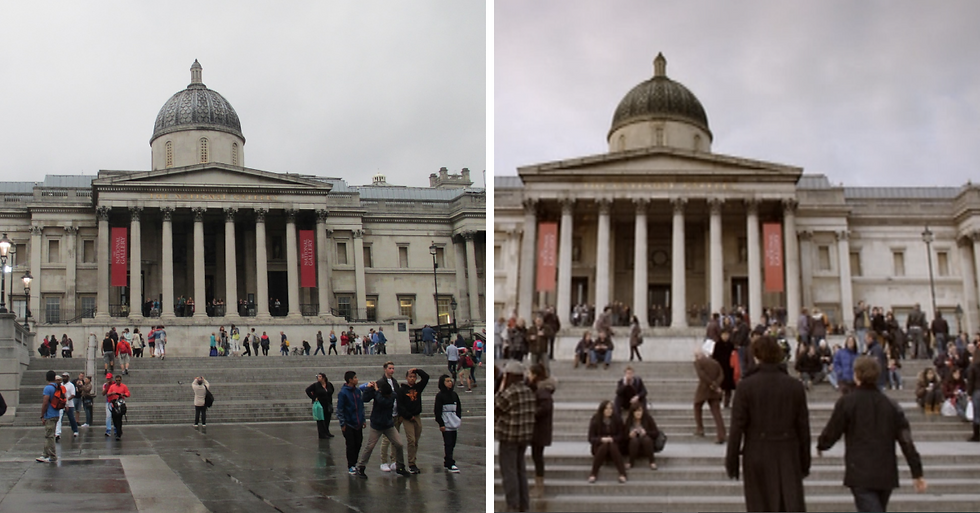
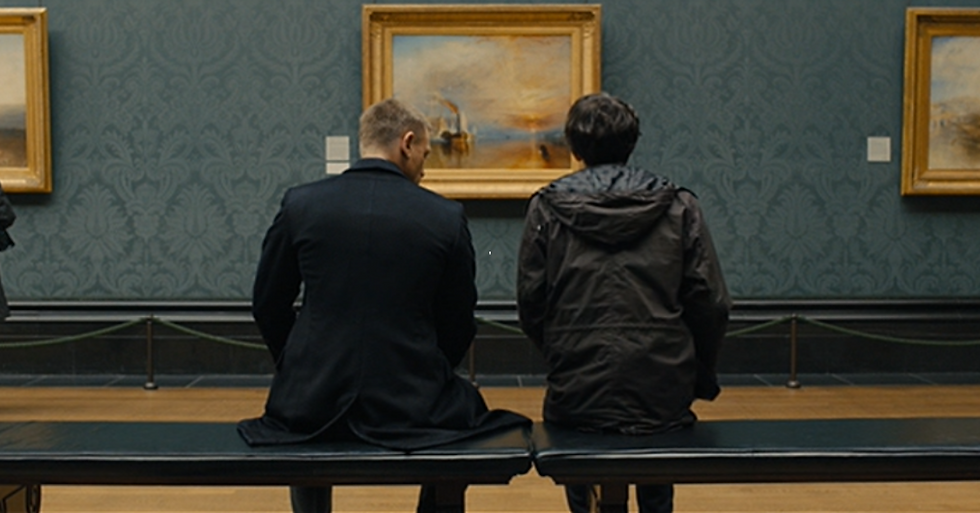
Why? Partially because it’s The National Gallery and is home to some of the most precious pieces of art in the world. A little bit because Sherlock and John walked across Trafalgar Square in search of a street artist (above right). Mostly, because in Skyfall, James Bond (Daniel Craig) meets his new Quartermaster (Ben Whishaw) while sitting in front of the Turner painting of “a bloody big ship" (below). I was so excited to sit in front of the portrait and drive Ann batty by reciting the entire scene that I was able to ignore the stomachache slowly making itself known.

The original Gallery was literally the house of the man whose collection was shown: banker John Julius Angerstein. The current building opened in 1838 and was meant to be for everyone to visit - perfect location, extended hours, and free. According to the National Gallery website, “the building now has a total floor area of 46,396 meters squared - roughly big enough to hold over 2,000 London double-decker buses.”
Unfortunately, due to a security guard strike, many of the more popular rooms were closed, and that included the one housing The Fighting Temeraire by Joseph Mallard William Turner. (I cannot say his full name without thinking of Orlando Bloom in the Pirates of the Caribbean movies.) Not even sweet talking one of the information desk personnel and then trying to prey on their guilt since I‘d come all the way from America just to see it helped. Disappointed, we explored the areas we could, I revealed that all I know about art is “I like what I Iike,” and planned for a future visit.

On the way out, we stopped at the gift shop and I purchased a postcard and a magnet of The Fighting Temeraire as consolation prizes. Next time… (Or perhaps not, as at the time of writing, the painting is not on display at the National Gallery. Hopefully it will return soon!)
Near the National Gallery is The Sherlock Holmes, a Sherlock themed pub that holds the first collection of Sherlock Holmes memorabilia that was used in an exhibition for the 1851 Festival of Britain. Upstairs is a detailed replica of Sherlock’s apartment that even includes the chair that Arthur Conan Doyle sat in while writing some of his Sherlock Holmes adventures.

The location itself, at 10 Northumberland Avenue (Street), is a special one. It was formerly the site of the Northumberland Arms which featured in the Sherlock Holmes story “The Adventure of the Notable Bachelor.” Holmes visits “a hotel on Northumberland Avenue” in his quest to solve the case of a missing new bride - that hotel is thought to be the Northumberland Arms.
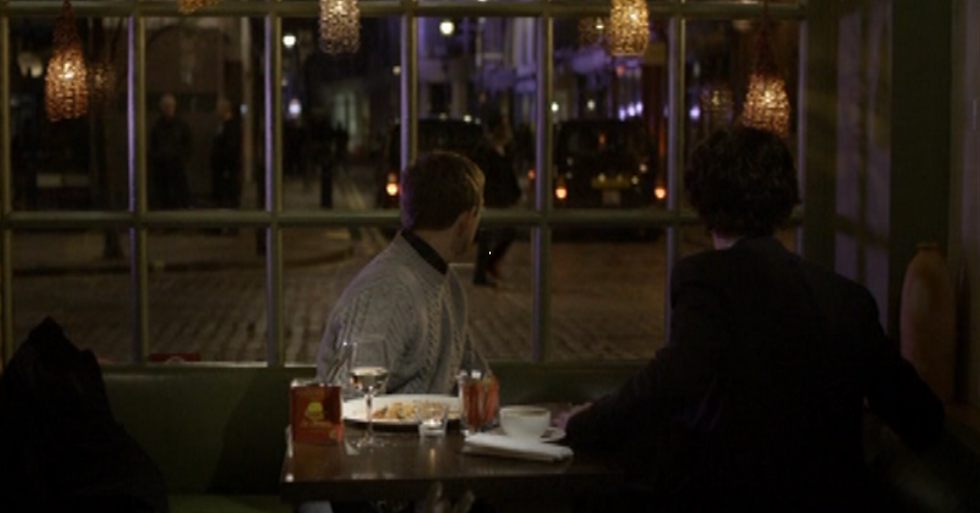
Another Northumberland connection is in the very first episode of BBC’s Sherlock, when Sherlock and John wait inside Angelo’s restaurant for the killer to show up at 22 Northumberland Street (above).
It was dark when we arrived and the pub was crowded, but we managed to find a seat. Ann ordered us both a pint, while I tried to look around but with so many people standing to chat with other patrons, I could only see some of the very cool pictures of the actors who have portrayed Sherlock Holmes over the years, and the small screens playing an episode of the BBC’s Sherlock.
Unfortunately, the stomachache I was trying to ignore, as well as a headache, made me unfit for the beer and the pub that seemed to be getting hotter and louder with every breath. I felt just as terrible asking to leave, but Ann suggested that getting outside might help. We left The Sherlock Holmes with me promising I would be back to not just finish a pint, but to have a better and longer look around at the memorabilia.
We walked to Covent Garden, and thankfully by the time we arrived I wasn’t ready to pay for a cab to take us straight home.

Since we were there at night, the market (above), shops, and some of the restaurants were closed, but that was okay with me. When I was a teenager I got hooked on historical romances (yes, those bodice rippers from the 80’s and early 90’s) and especially loved the ones that took place in Victorian London. Covent Garden, Drury Lane, these were the places where the head-strong heroines would take off to for an investigation or simply to see what the fuss was about - and by going at night it was even more exciting because it was just not something a good woman would do!
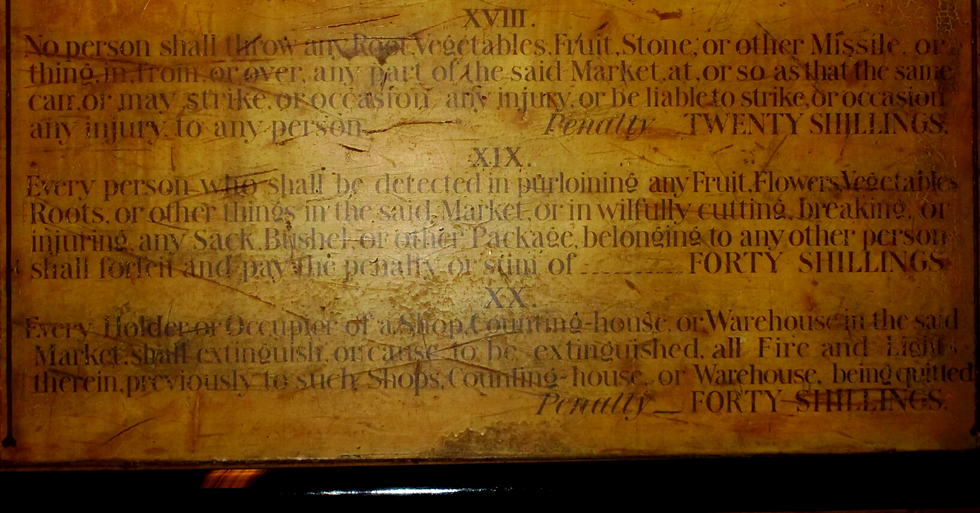
Some of the Covent Garden "Rules and Bye-Laws".
I haven’t read any of them in years, but that is what I remembered as we walked around the cobblestone square and I tried to take pictures of everything. Covent Garden, originally the garden of the Convent of St Peter, has been the home of a market of some sort since 1656, and now boasts of a variety of modern shops and stalls to peruse. There are also many restaurants and pubs to visit, making it, as the Covent Garden website says, “a foodie’s paradise.”
The Theatre Royal in Drury Lane is the oldest theatre in London, and supposedly the Earl of Sandwich created his namesake in Covent Garden when he ordered some meat to be placed between bread to keep his hands free from grease while playing cards.
Covent Garden has hosted concerts and been the location for several films, including scenes from Mary Poppins Returns (Mary and the children have a bowl repaired at a shop in Goodwin’s Court) and Spectre (M’s supper is interrupted by Q and Moneypenny in Rules restaurant on Maiden Lane). While we didn’t visit these sites, it shows just how big the area of Covent Garden really is, outside of the main market. The map available on the Covent Garden website can give you an even better idea.
From Covent Garden we walked past the Forbidden Planet Megastore (where, in 2009 I bought so many Torchwood and Doctor Who books and action figures that Ann had to send them home to me by post because they wouldn’t fit into my bag - it’s glorious), but it was closed, and then to Soho.

Old Compton Street (above), considered the center of London’s gay community, is a great place to be on a Friday night. The street was packed with people, mostly queuing up to get inside one of the many clubs.

During my last visit we walked through Old Compton on an early Monday morning to get breakfast at Patisserie Valerie, one of the few places open, so to see the club and shop signs lit and people dancing to the faint music thumping through the stone walls was so much fun! I even got to see a go-go dancer through the window of the Village - he moved like he was underwater he was so graceful. Also had the interesting experience of not realizing I was standing next to an outdoor urinal when a gent in a very nice suit walked up and did his thing. We hastily left the vicinity before I started laughing.

We caught the Tube out of Piccadilly to head back to Ann’s flat. There was barely any time to write about our day’s adventures before I fell asleep. It was, according to my journal, 12:22am when I finished that day’s entry. I slept very, very well that night.
Comments